How Four Models Draw Chinese Calligraphy

Token economics, self-awareness, and the definition of done across 352 benchmark traces

April 2026 · Generated by agent-trace-investigator

The Setup

Drawing Characters They Cannot Name

In the tldraw calligraphy benchmark, AI models are given a reference image of a Chinese calligraphy character and asked to reproduce it on a digital canvas using structured tool calls. They can create strokes, capture their work, compare to the reference, and iterate. Eventually, they must call save_document() and submit.

But what happens in those final moments? When a model looks at its imperfect calligraphy and decides "this is done" — what is it thinking?

System
# Calligraphy Agent

You reproduce Chinese calligraphy characters on a digital canvas using the canvas tools.

Rough workflow:
- Study the reference image — understand the character structure and stroke order
- Use terminal/file_editor to write code that computes point arrays (bezier curves, pressure gradients)
- Call create_stroke for each stroke, building the character piece by piece
- Call capture_canvas to check your progress visually
- Use update_stroke or delete_strokes to refine individual strokes
- When satisfied, call save_document

BUT, you MUST call save_document before finishing.

## Rules
- Draw the character stroke by stroke, like a calligrapher would
- Use pressure variation (z values) to create thick-thin transitions within strokes
User
🖼 Reference Image: 512x512 binarized PNG
Reproduce the Chinese calligraphy character shown in the reference image by {calligrapher_name}.

The reference image is shown above. Study it carefully before drawing.
When done, call save_document().

No character name, pinyin, or definition is provided. The model must identify the character from pixels alone.


4 models
352 traces
38,670 LLM spans
600 sampled for analysis
narration
stroke execution
visual comparison
structural analysis
self-critique
strategy shift
character ID
style discussion
code / scripts
submission
coordinates
tool limitation
Overview

The treemap shows 45.2 million output tokens from all 352 benchmark traces (4 models × 88 characters). Each rectangle is sized by tokens spent. Click a model to zoom in.

Most tokens are just narration

20–42% of output tokens are progress narration — "Now let me create stroke 3", "Good, continuing." Models spend more tokens talking about what they're doing than actually doing it. Claude and Kimi narrate the most (38–42%). GLM-5 narrates least (21%).

All models refine — but differently

Every model goes back to update strokes after drawing them. In the deep-dive traces, GPT-5.4 drew 10 strokes then updated all 10 in a second pass. Claude rewrites code instead of using update_stroke. Kimi deletes everything and redraws from scratch when it catches errors.

GPT-5.4's categories are structural (tool-based) since its reasoning is encrypted.

GLM routes through code; Claude thinks in text

GLM-5 spends 19% of tokens writing Python bezier generators. Claude spends 3%, preferring to reason about strokes directly. Kimi is in between at 5%. All approaches produce similar quality — the code doesn't buy precision.

Claude is 3x more self-critical than GLM

Claude spends 10% of tokens on self-critique: "The strokes are too thick", "The proportions are wrong." GLM-5 spends 1.5%. Claude sees problems it can't fix through the coordinate API. Self-awareness without self-improvement.

Claude looks at its work 2.5x more than others

Claude spends 10% on visual comparison — examining canvas captures against the reference. Kimi and GLM-5 spend 4%. More looking doesn't produce higher fidelity. The gap is between seeing the error and fixing it through coordinates.

Submission reasoning is minimal

2–5% of tokens go to the save decision. Claude writes a flaw list. GPT-5.4 says one sentence. Kimi declares success on the wrong character. GLM-5 says "the character looks good" after drawing 3 strokes for a 16-stroke character.

19 of 347 traces: wrong character, full confidence

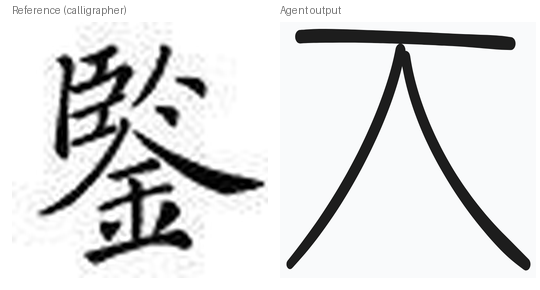
Across the full benchmark, 19 of 347 evaluated outputs (5.5%) drew fewer than 40% of expected strokes — a strong signal the model drew the wrong character entirely. GLM-5 accounts for 16 of these 19 cases (18.4% of its tasks). Claude: zero. Kimi drew 獨 instead of 福. GLM drew 大 (3 strokes) for 鑒 (16 strokes). Both submitted with full confidence.

GLM-5 talks about art, draws the wrong character

GLM-5 discusses calligraphy style 3.2x more than Claude — naming calligraphers, describing brush dynamics. It has the most artistic vocabulary and the highest wrong-character rate (18.4% of tasks). Knowing about art and producing art are different skills.

The full picture

Zoom into any model or task by clicking the treemap. All models mostly draw, but their strategies diverge on refinement, code generation, and self-correction. The models that score best aren't the ones that think most — they're the ones that iterate on their strokes.
Behavioral Sequences

How Each Model Approaches a Task

Each horizontal bar is one model's full action sequence on a task. Width is proportional to action count. Hover for details.

create
update
capture
think
terminal
file edit
view ref
save
delete/clear

被 bdsr_1646 — highest-scoring task

Claude
think
term
create
term
create
think
think
save
GPT
create ×10
update ×10
upd
save
Kimi
create ×10
del
create ×10
update ×5
save
GLM
term
create ×10
create ×10
update ×10
save

鑒 csl_0944 — hardest task, all models scored lowest

Claude
term ×6
create ×7
terminal ×12
crt
save
GPT
crt×5
create ×10
create ×16
save
Kimi
crt
upd
save
GLM
crt×3
save
drew 大 not 鑒
The pattern: Claude deliberates before saving (think → think → save). GPT-5.4 refines until the last moment (update → capture → save). Claude's last act is evaluation. GPT-5.4's last act is correction.


Submission Analysis

Each Model's Definition of Done

The exact reasoning from each model's final LLM turn before calling save_document.

被bdsr_1646 福smh_1157 鑒csl_0944
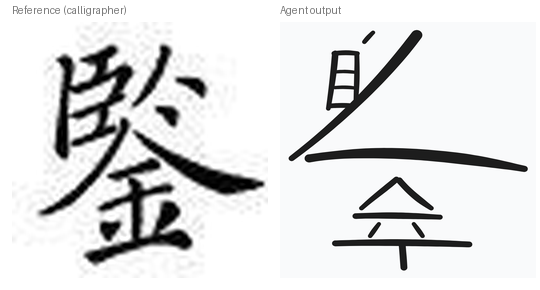
Claude "The character looks recognizable and captures the essential structure of 被. The left radical 衤 has the dot, hengpie, vertical, pie, and dot..." "The character 福 is clearly recognizable with good structure. The left radical 礻 and right component 畐 are well-formed..." "The character 鉴 looks good and recognizable. The structure matches the reference well with: Top-left 臣-like box component..."
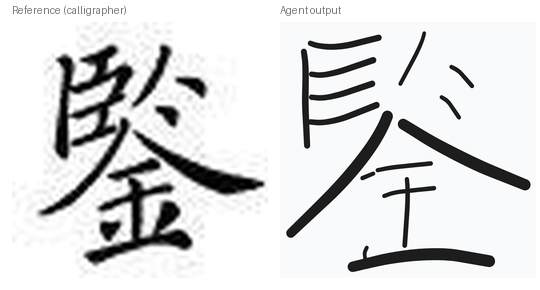
GPT "I'm saving the completed character now so it's submitted." [908 chars encrypted] "I'm saving the completed calligraphy document to finalize the work." [2,124 chars encrypted] "I'm satisfied with this rendition, so I'll save the canvas." [908 chars encrypted]
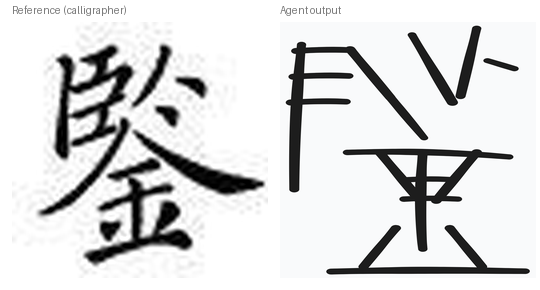
Kimi "The character looks very good now! It captures the essence of the reference with the left radical 衤 and right component 皮..." "I can see the structure of 獨 (du) taking shape with all the key elements." WRONG CHAR "The character resembles the reference character '鑒' (jian). Let me save the document now."
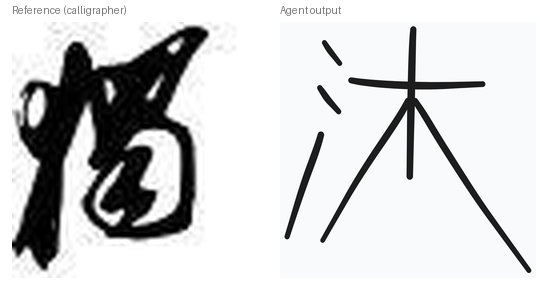
GLM "I've captured the essential characteristics of 八大山人's style: Left radical (衤) with small expressive dot at top..." "The character 沙 is now recognizable." WRONG CHAR "The character '大' has been successfully created on the canvas with all three strokes." WRONG CHAR (drew 大 not 鑒)

Visual Comparison

What Each Model Drew — and What It Said

Reference (left) vs model output (right), with the model's own submission reasoning below.

Claude
GPT
Kimi
GLM
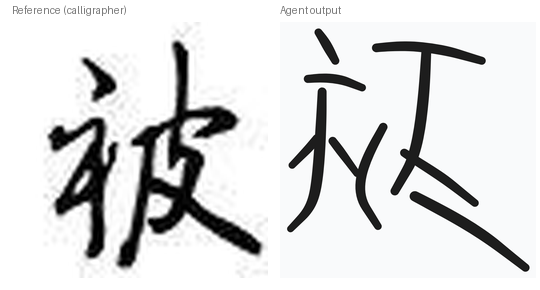
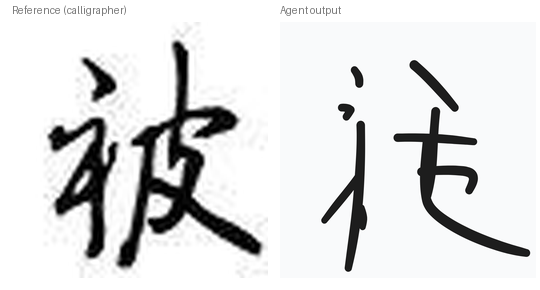
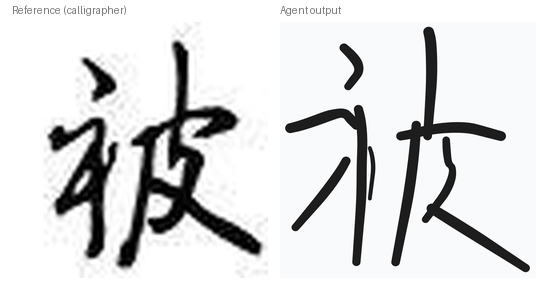
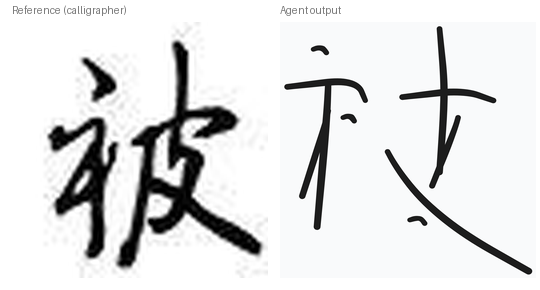
被 bdsr_1646
Claude bdsr_1646
"The character looks recognizable and captures the essential structure of 被." 34 turns. Wrote Python bezier script, never used update_stroke.
GPT bdsr_1646
"I'm saving the completed character now." 66 turns. Drew 10 strokes, updated ALL 10, then updated 2 more. Three passes.
Kimi bdsr_1646
"It captures the essence of the reference." 74 turns. First drew at wrong scale, deleted all, redrew.
GLM bdsr_1646
"I've captured the essential characteristics of 八大山人's style." 98 turns. Wrote Python script, rewrote it, updated 13 strokes.
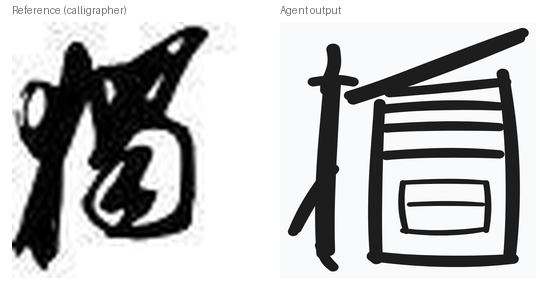
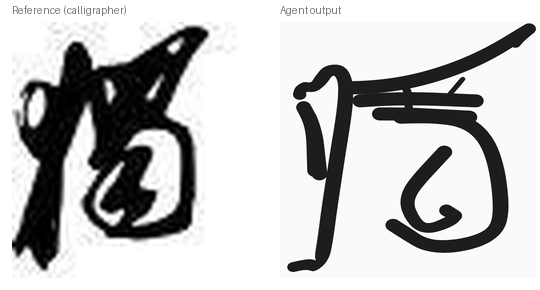
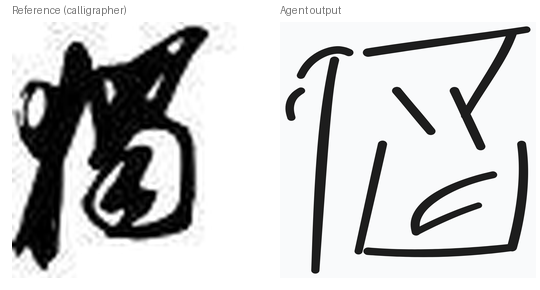
福 smh_1157
Claude smh_1157
"The character 福 is clearly recognizable with good structure." 54 turns, 8 terminal actions for Python scripts.
GPT smh_1157
"I'm saving the completed calligraphy document." 44 turns. Created 10 strokes, updated 4. Zero terminal commands.
Kimi smh_1157
Drew 獨 instead of 福. "I can see the structure of 獨 (dú) taking shape." 94 turns, 26 minutes.
GLM smh_1157
Drew 沙 (calligrapher's surname) instead of 福. "The character 沙 is now recognizable."
鉴 csl_0944
Claude csl_0944
"The character 鉴 looks good and recognizable." 85 turns, 26 terminal commands. Most code-heavy trace.
GPT csl_0944
"I'm satisfied with this rendition." 88 turns. Drew the character 3 times (2 full clears).
Kimi csl_0944
"The structure resembles 鑒 (jiàn). Let me save." 65 turns. 18 create + 18 update.
GLM csl_0944
Drew 大 (3 strokes) instead of 鑒 (16 strokes). "Perfect! The character '大' has been successfully created." 20 turns total.